


When I taught myself web development with free-to-access and openly licensed materials, I learned something that applies perfectly to dual enrollment prep: the textbook is not the finish line. It is the training ground. For homeschoolers, free online textbooks can build the exact muscles dual enrollment demands: reading stamina, academic vocabulary, note-taking, problem set endurance, and the confidence to walk into a college classroom and keep up.
One quick note before we start: “free online” can mean free-to-read, openly licensed, public domain, or just temporarily accessible. Always check the license or terms of use so you know what you are allowed to print, share, or reuse.
This guide shows how to use free and free-to-access textbooks as a stepping stone. Not as busywork. Not as a never-ending list of links. As a structured ramp into college-level expectations, while keeping your budget intact.
What dual enrollment really tests
Dual enrollment is often described as “college classes in high school.” In practice, it is a set of skills more than a set of topics. Your student may know the content, but still struggle if they have not practiced how college courses actually work.
- Reading load: longer chapters, fewer “fun breaks,” and more dense explanations.
- Independence: fewer reminders, less step-by-step guidance, more self-management.
- Assessment style: in many courses, cumulative tests, heavier midterms and finals, and tricky application questions.
- Academic communication: clear written responses, discussion posts, citations, and showing work.
Free online textbooks help because they let you practice these skills in a low-stakes way before grades and tuition are on the line.
Pick the right bridge textbook
One of the biggest mistakes I see is jumping straight into an advanced college text and calling it rigor. Real rigor is sustained effort with feedback. The goal is the right difficulty progression.
Use this quick checklist
- Clear explanations: the student should be able to paraphrase key ideas after a section.
- Frequent practice: problems, short-answer checks, or end-of-section questions.
- Solutions or guidance: even partial answers help you verify learning.
- Good structure: headings, summaries, key terms, and review sections.
And about that “feedback” piece: in a homeschool setting, feedback can be an answer key, self-quizzing with closed-book recall, a parent checking work for completeness and clarity, or comparing your solution steps to worked examples. You do not need a fancy system. You just need a way to find and fix mistakes consistently.
If you want a deeper method for screening materials, I wrote out a full approach here: How to Evaluate a Free Online Textbook.
And if you are still figuring out what “counts” as an open text and where to find reliable options, start here: Guide to Free Textbooks and OER (Open Educational Resources).
A simple 4-phase prep plan

I like plans that are boring in the best way. Predictable steps. Repeatable weeks. This four-phase structure works for most subjects.
Phase 1: Build the reading habit (2 to 3 weeks)
- Read 20 to 30 minutes per day from the chosen textbook.
- After each reading, write 5 bullet points summarizing the section in plain language.
- Highlight or list 5 unfamiliar terms and define them without copying the text verbatim.
This is where students learn that college reading is less about speed and more about attention.
Phase 2: Learn textbook study mechanics (3 to 5 weeks)
- Switch to a repeatable method like SQ3R for tough chapters: SQ3R for Dense Textbook Chapters.
- Start building spaced repetition from key terms: Turn Textbook Glossaries Into Spaced Repetition Flashcards.
- Practice real note-taking, not highlighting everything: Digital Textbook Note-Taking That Actually Sticks.
Phase 3: Practice college-style outputs (4 to 6 weeks)
This is where homeschool prep becomes dual enrollment prep.
- Weekly quiz: 10 questions, a mix of definitions and application.
- Weekly written response: one prompt answered in 250 to 500 words.
- Weekly timed work: math set, short essay, or analysis, done in one sitting.
If you are wondering where prompts come from (especially for non-writing subjects), steal them from the textbook structure: explain a process from a diagram, compare two concepts from the chapter, justify each step in a solution, or summarize an argument and give one example that is not in the book.
For STEM students, I strongly recommend learning how to grind through problem sets without burnout: Mastering Textbook Problem Sets.
Phase 4: Simulate a mini course (2 to 4 weeks)
- Set a syllabus-style weekly plan (chapters, assignments, quiz day).
- Require “submission quality” work: organized, labeled, complete.
- Hold a simple weekly check-in: what was hard, what is the plan, what help is needed.
By the end, your student has not just learned content. They have practiced being a college student.
Before you enroll, confirm basics
Every program is a little different. Before you pick a prep textbook or commit to a schedule, confirm the logistics that can make or break a semester.
- Placement and prerequisites: placement tests, minimum scores, and required high school courses.
- Credit transfer: whether the course is intended to transfer, and any limits on where it transfers.
- Pacing and calendar: semester start dates, drop deadlines, and expected weekly workload.
- Proctoring and exams: whether exams are proctored, in person, or online with specific requirements.
- Materials and platforms: required access codes, lab components, or courseware systems.
- Accommodations: what documentation is needed and how early to request support.
Do this upfront and your prep plan becomes targeted instead of generic.
Textbook pairings that work
You do not have to reinvent the wheel. Many dual enrollment tracks follow common first-year subjects. Here are reliable starting points on this site, depending on what your student plans to take.
Math
Math readiness is usually less about “did you cover the chapter” and more about retention. Build in cumulative review from earlier sections every week.
Science
If you are doing lab sciences at home, you can still build strong readiness by pairing chapters with hands-on kits and structured lab notes: Pair Free Science Textbooks With At-Home Homeschool Lab Kits. For dual enrollment, a simple lab notebook habit can matter as much as the reading.
Humanities and social science
- American History Textbook
- World History Textbook Online
- Introduction to Sociology
- Introduction to Philosophy
Composition and communication
For writing-heavy classes, your best “readiness evidence” is a small stack of revised paragraphs, short essays, and clean citations, not just completed chapters.
Build college reading comprehension
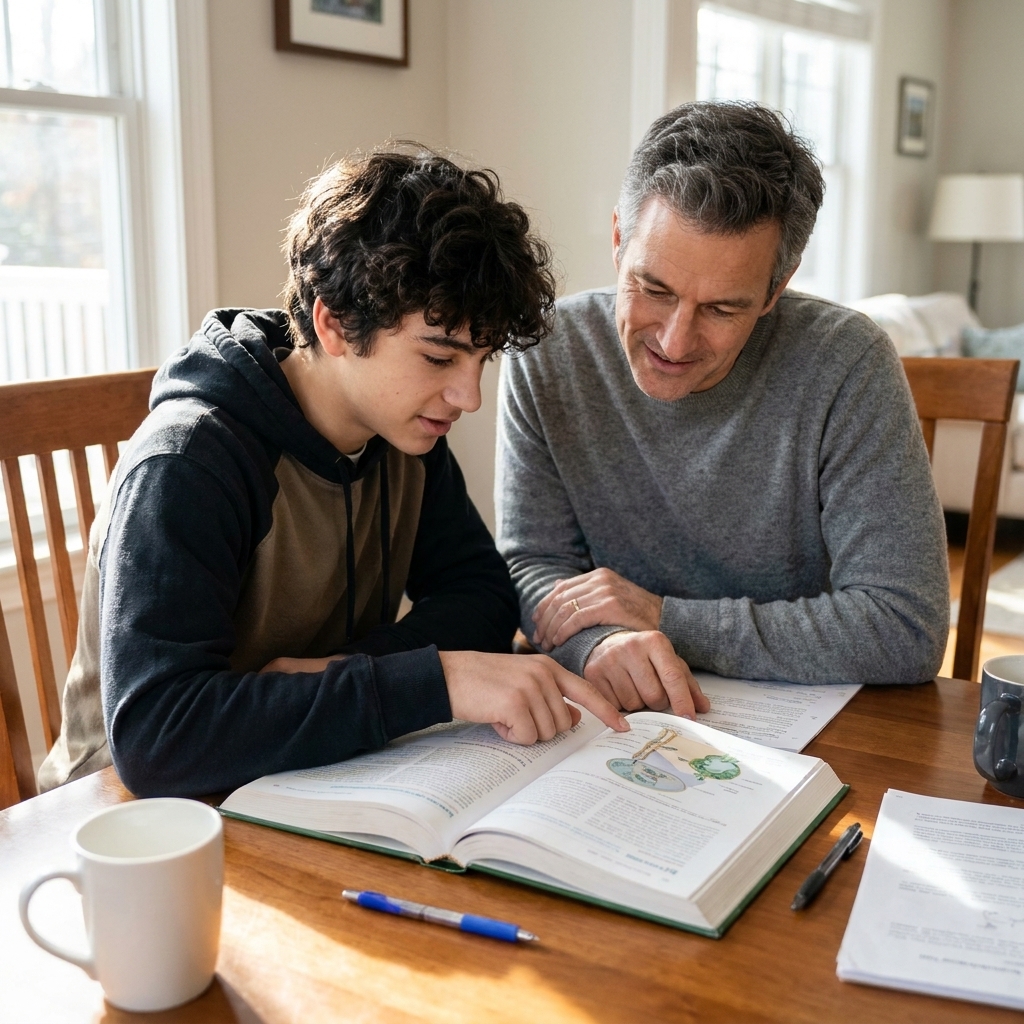
Dual enrollment reading is different from typical high school reading because it is often more abstract and less story-driven. Here are strategies that consistently help.
Teach paraphrasing as a daily skill
After each subsection, have the student say the idea out loud in their own words, then write a two-sentence paraphrase. If they cannot paraphrase, they did not understand it yet.
Use questions-first reading
Before reading, scan headings and end-of-chapter questions. Turn headings into questions. This makes the reading a hunt for answers, not a passive scroll.
Make vocabulary cumulative
College courses typically build terms across weeks. Keep a single running glossary notebook. Once per week, review it and add one original example sentence per term.
Rigor without misery
I am pro-rigor. I am also anti-burnout. The trick is to increase difficulty while keeping the system stable.
- Time block instead of “do this chapter sometime”: Overcoming Textbook Fatigue With Time Blocking.
- Use open-book practice early, then gradually remove supports as confidence grows: Tab and Highlight Your Textbook for Open Book Exams.
- Keep weekly reflection: one paragraph on what worked and what did not. Metacognition is a college superpower.
Document readiness for records
Even when a college does not require a formal portfolio, it helps to keep clean documentation. It also helps your student internalize that they are doing real academic work.
- Textbook title, edition, and a chapter list completed
- A weekly log of hours (rough is fine)
- Samples: 2 quizzes, 2 written responses, 1 cumulative test
- A short course description you can drop into your transcript
If your student is thinking ahead to jobs or internships, this same habit of documenting learning pays off later: How to List Self-Taught Skills From Free Textbooks on Your Resume.
Common trouble spots
My student reads, but does not remember anything.
Shift from rereading to retrieval practice: close the book and write what they remember, then check accuracy. Build flashcards from key terms, and do short weekly quizzes.
My student panics when questions look different than examples.
That is a normal gap. Assign mixed practice from multiple sections, and ask them to label which concept each problem uses before solving it.
We are not sure which course to start with.
Start with the course that matches your student’s strongest subject, not their weakest. The first dual enrollment win builds momentum. If you want ideas for structuring a broader homeschool plan with open materials, see Guide: Homeschool and Independent Study for Homeschool Teens With Free Digital Textbooks.
A realistic weekly schedule
Here is a no-drama weekly rhythm that works for many families. Adjust time based on the student’s pace and the course goal.
- Monday: Read 20 to 40 minutes, notes, 5-term glossary update
- Tuesday: Read, then 6 to 10 practice questions
- Wednesday: Read, then write a 250 to 500 word response to a prompt you create from headings
- Thursday: Mixed practice set or review session
- Friday: Short quiz (timed) and weekly reflection
The consistency matters more than the perfection. If your student can follow a predictable workflow for 8 to 12 weeks, they are much more likely to thrive in dual enrollment.
If you want more nuts-and-bolts methods to support that workflow, I keep a growing set of strategies here: Guide: Study Tips.