

I learned to study independently the hard way: no tutors, no pricey programs, just a stack of free online materials and a lot of trial and error. That is why I am such a believer in open educational resources for homeschoolers. Not because they are free, although that helps, but because good OER makes it easier to practice the exact skill your student needs next.
If you have a middle or high schooler who still needs you to drive every lesson, switching to independent study can feel like handing them the keys to a car before they have used the turn signal. The goal is not to disappear overnight. The goal is a gradual handoff where your teen gains the habits colleges, trade programs, and real jobs quietly assume they already have.

What independent study means
Independent study is not “teach yourself everything with zero support.” It is a structured routine where your teen can:
- Plan what they will cover this week.
- Learn from a textbook or course resource without being lectured at.
- Practice with problem sets, prompts, labs, or projects.
- Check their understanding using answer keys, self-quizzes, or rubrics.
- Report back to you briefly, in a short weekly check-in (like a standup meeting).
Your role changes from primary instructor to coach, editor, and accountability partner.
Start with a small pilot
In my experience, the fastest way to make independent study fizzle is to demand it across every subject at once. Pick one subject for a 3 to 4 week pilot, ideally one that already has clear practice built in.
Good first subjects
- Math, because feedback is immediate and practice is naturally chunked. If you need a starting point, our pages on algebra and geometry are a helpful launchpad for free or low-cost online textbook options.
- Intro science, if you can pair reading with short, repeatable labs or observation logs. See biology for options.
- History, if your teen can write and discuss. Try American history or world history as a base text.
During the pilot, you are not trying to cover a heroic amount of content. You are trying to install a process that will still work in February when motivation is lower.
A simple handoff plan
This is a transition pattern I have seen work often with teens, especially those who are used to parent-led instruction.
Week 1: I do
You model the workflow start to finish in front of them. That includes the unglamorous parts: checking the table of contents, deciding what counts as “done,” and what notes to take.
Week 2: We do
They drive the session, but you sit nearby and prompt with questions instead of solutions.
Week 3: You do
They complete the work solo. You only step in at pre-set checkpoints.
Week 4: You report
They run a short weekly meeting where they show you:
- What sections they completed
- Practice scores or corrections
- One thing they found confusing
- What they will do next week
This last step is the part that tends to change everything. “Reporting” turns independent study into a real commitment, not a vague intention.
Choose OER they can use alone
Not every free textbook is easy to use independently. Some are excellent references but terrible teachers. Before you commit, do a quick evaluation using three questions:
1) Does it have enough practice?
For independent study, practice is not optional. Look for end-of-section questions, worked examples, or prompts with clear expectations. If you want a deeper checklist, use how to evaluate a free online textbook.
2) Is the reading load realistic?
If a chapter is 35 pages of dense text, your teen will either skim or stall. You can still use that book, but you will want to assign smaller chunks and teach a reading system.
3) Is it organized for self-navigation?
Independent learners need predictable structure: learning objectives, headings that mean something, summaries, and review sections. The more consistent the layout, the easier it is for your teen to build a routine.
For a broader orientation to open resources, start here: OER (Open Educational Resources).
Build a weekly rhythm
Teens do better when independence is a checklist, not a vibe. Here is a repeatable weekly rhythm that works well with digital textbooks.
The 3-2-1 weekly plan
- 3 study blocks (45 to 75 minutes each) for reading and notes
- 2 practice blocks for problems, writing, or labs
- 1 review block for self-testing and corrections
If your teen struggles with consistency, add time blocking. I wrote about this in overcoming textbook fatigue with time blocking.
Note-taking for digital textbooks
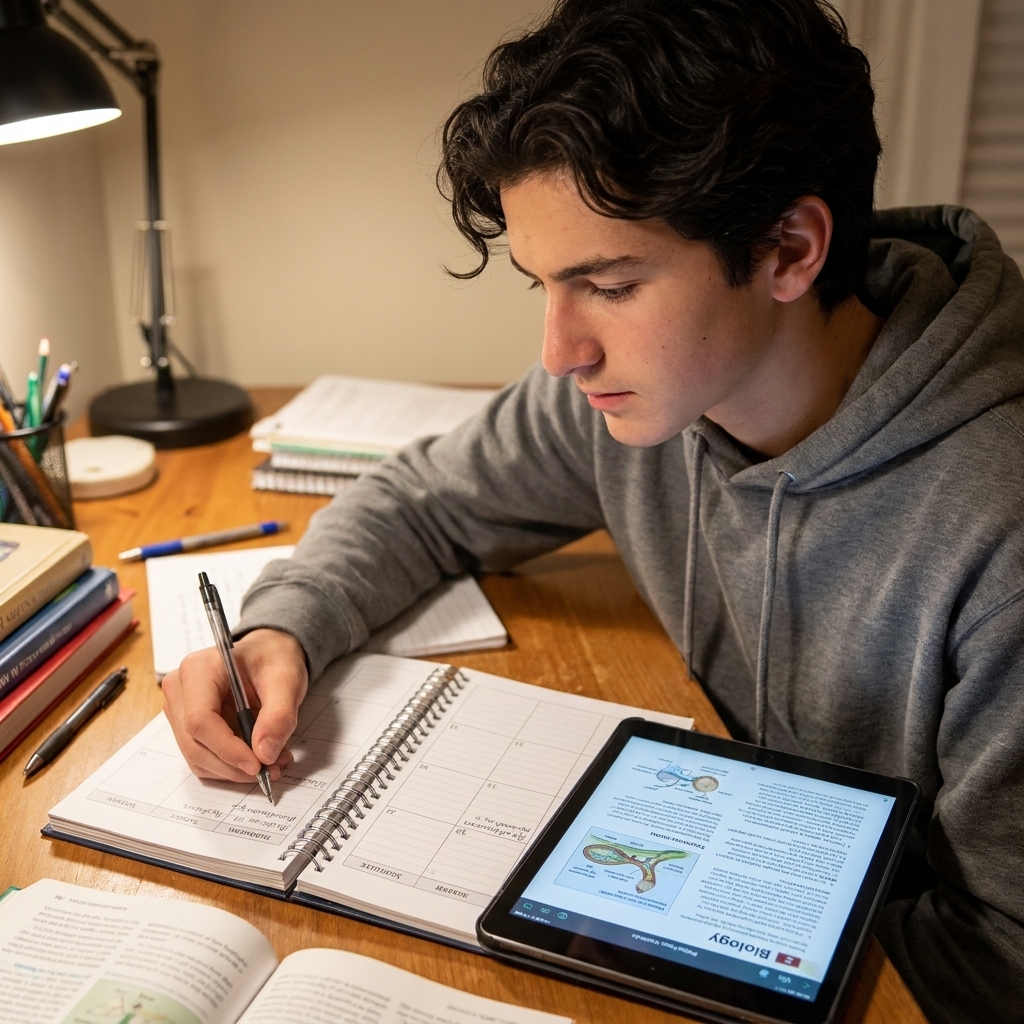
Most teens either highlight everything or take no notes at all. Both are a waste. The goal is to leave behind a trail of thinking they can review quickly.
A note system I like
- One page per section, even if it is mostly empty.
- Five bullets max for key ideas in their own words.
- One worked example or one “mini summary” they can reproduce without looking.
- One question they would ask a teacher.
If you want a more detailed approach, see digital textbook note taking that actually sticks.
Accountability without hovering
Independent study falls apart when there is no feedback loop. It also falls apart when the parent becomes a full-time hall monitor. The middle path is a small set of predictable checkpoints.
My favorite checkpoints
- Daily start: They tell you the single task they will finish today.
- Midweek check: A 5 minute glance at their notes and practice.
- Weekly review: They show corrected work and explain one concept out loud.
If your teen needs help learning how to read a chapter efficiently, teach a method like SQ3R. We have a walkthrough at SQ3R for dense textbook chapters.
Make practice feel real
Digital textbooks can turn into passive scrolling if there is no output. You can fix that by attaching one concrete product to each unit.
Examples that work
- History: A 2 page briefing memo written for a specific audience, like “a city council member” or “a museum visitor.”
- Biology: A weekly observation log, simple home lab notes, or a labeled sketch they redraw from memory.
- Math: A mixed review set they design for themselves, plus corrections and explanations.
- Communication: A short recorded talk and a self-critique using a rubric. You can use The Art of Public Speaking as a text base.
If your teen is motivated by building things, you can also use the “textbook to portfolio” idea even in high school. See from page to practice.
When they get stuck
One of the most important independence skills is learning what to do when you do not understand something. I teach teens a ladder so they do not jump straight to “I can’t.”
- Re-read one paragraph and restate it in simpler words.
- Work one example slowly, copying steps.
- Check the glossary and define key terms.
- Search inside the book for the term and read another explanation.
- Write a specific question that includes where they got lost.
- Then ask you, or use a safe external resource.
For finding credible academic explanations, Google Scholar can be useful for older teens, especially when you are vetting sources together.
Document the work
If you report to an umbrella school or your state expects records, independent study can actually make documentation easier, as long as you decide what counts as “proof” ahead of time.
Simple documentation that holds up
- Weekly plan plus completion notes: a short list of sections covered and what was turned in.
- Work samples: keep 1 to 2 representative pages per week (or a photo if it is messy).
- Quiz snapshots: a quick self-quiz score, plus corrections.
- Reading log: chapter titles and dates, especially for history and literature-heavy courses.
- Portfolio pieces: projects, lab notes, presentations, and final drafts.
You do not need to save everything. You need a clean trail that shows progress over time.
For learning differences
If your teen has ADHD, dyslexia, slow processing speed, or they are just a reluctant reader, you can still build independence. You just build it with smaller blocks and clearer supports.
Small tweaks that often help
- Shorter blocks: try 20 to 35 minutes with a timer, then a quick reset.
- More output, less copying: oral summaries, a one-minute voice note, or a concept map instead of long written notes.
- Audio support: if reading is the bottleneck, consider pairing print with audio options. Our audio textbooks page can help you explore what is out there.
- Reduce the reading, keep the reporting: cut the assignment in half, but keep the weekly check-in so the habit still grows.
The win here is not speed. It is repeatability.
A 2-week transition plan
Week A: shared control
- Monday: Choose sections and define “done” together.
- Tuesday: Teen studies independently, then explains one concept aloud.
- Wednesday: Practice set with corrections.
- Thursday: Independent reading plus notes.
- Friday: Quick quiz or summary and a 10 minute weekly review.
Week B: teen-led
- Monday: Teen proposes plan for the week. You approve or adjust.
- Tuesday to Thursday: Teen executes with one midweek checkpoint.
- Friday: Teen reports progress, shows evidence, sets next week’s plan.
After two weeks, you will know what needs adjusting: workload size, reading strategy, or accountability.
Free textbook sources
If you are new to OER, it helps to know where to look. I keep my own approach simple: start with a known hub, then evaluate each book like you would a curriculum purchase.
- Free eTextbooks for general options.
- Online textbooks for a broader scan of platforms and formats.
- OpenStax vs LibreTexts for self learners if you are comparing two popular OER ecosystems.
- NCERT online textbooks if you want structured, full-course sequences that can feel straightforward to follow, especially when you want a clear chapter-by-chapter path.
FAQ
What age is realistic for independent study?
Many students can start a guided version in middle school, especially with one subject. Full independence is more realistic in high school, but it depends more on habits than age.
Should I grade everything?
No. Grade for feedback, not for control. For math and science, spot-check and focus on corrections. For writing, use a rubric and only do deep feedback on one piece per week.
What if my teen reads but does not retain?
Shift from highlighting to retrieval practice: short self-quizzes, closed-book summaries, and teaching the concept out loud. Also consider spaced repetition from glossary terms. We cover that idea in turn textbook glossaries into spaced repetition flashcards.
What if they refuse because it feels too hard?
Reduce the scope, not the expectation. Assign half the reading, but keep the reporting meeting. Independence grows when the routine is doable and consistent.
The real win
The best part of switching to independent study is not that you get your time back. It is watching your teen realize they can take on a new subject without waiting for someone to spoon-feed it.
Free digital textbooks make that transition easier because you can experiment without financial pressure. Try one subject, run a short pilot, and focus on habits: planning, practice, feedback, and reporting. Those skills outlive any single curriculum.
If you want more homeschool-specific browsing, start with our homeschool guide.