
I learned web development from free materials long before “open educational resources” became a common phrase. It was empowering, but it also taught me something the hard way: free does not automatically mean reliable. Some community-contributed textbooks are better than expensive commercial ones. Others are outdated, lightly edited, or quietly wrong in ways that waste weeks.
This is the checklist I use before I commit serious study time to a free online textbook. It is designed for self-learners, homeschool families, and anyone trying to build practical skills without paying for a glossy cover.

Start with a credibility scan
Before you fall in love with a clean layout or a convenient PDF, do a fast pass for the basics. You are looking for clear ownership, transparency, and signs the book is maintained.
- Who published it, and is that reassuring? University program, nonprofit, or a recognized OER platform is usually a safer bet than an anonymous upload on a personal site with no editorial details.
- When was it last updated? Look for an edition number, revision date, or a changelog.
- Is there an author and editor listed? “Community” is fine, but there should still be named maintainers or an editorial board.
- Is the license clear? A Creative Commons license does not prove quality, but it does signal intentional sharing and makes reuse rights more transparent. If you plan to print, distribute, or remix, confirm the specific terms, not just that it is “free to read.” (If you are new to OER, see OER: Open Educational Resources.)
- Does it match your goal? A book can be accurate and still be wrong for you if it is too theoretical or missing practice.
Check the author
This is not about gatekeeping. It is about knowing what the author is qualified to teach and what they are trying to accomplish.
What to look for
- Relevant expertise: For a biology text, do they have academic or professional experience in biology? For a programming text, do they show real project work, teaching experience, or recognized contributions?
- Institutional context: Books produced through a college department or OER initiative often have review processes, even if informal.
- Contact and identity: A real name, affiliation, and a way to report errors. Anonymous can still be good, but it raises the burden of proof elsewhere.
My quick test
I search the author’s name and see if their background matches the scope of the book. If a “data science” textbook is written by someone whose public work is unrelated, I assume the book needs heavier verification before I trust it.
Look for an editorial process
Peer review can be one of the clearest signals that a book has been challenged by other knowledgeable people. It also varies a lot in OER and self-published contexts, so I treat “peer reviewed” as a starting point, not a seal of perfection.
Strong signals
- Specific peer review statement: The book explains who reviewed it and what criteria they used.
- Adoption or endorsement notes: A department or instructor has used it in a course, ideally with revision notes.
- Open issue tracking: There is a public list of reported errors and fixes. This is especially common in open-source style textbooks.
- Errata handling: An errata page, correction log, or visible update cadence tells you whether mistakes get fixed or quietly linger.
Weak signals (not useless, just weaker)
- Star ratings with no written feedback
- Testimonials that do not mention accuracy or learning outcomes
- Reviews that only praise the book for being free
If the book has no evidence of review, do not discard it automatically. Just move more of your trust to the next checkpoints: citations, cross-checking, and recency.
Check dates and versions
Outdated does not always mean wrong, but it often means incomplete or missing modern best practices.
- Find the last revision date: Not just the original publication date.
- Watch for “zombie textbooks”: A PDF uploaded in 2024 that is actually a 2012 edition with a new filename. My quick tell is to check the inside title page, preface, or copyright page and see if it matches the file name and the “last updated” claim.
- Look for version notes: Even a simple “What changed in this edition” section is a great sign.
Fields where recency often matters a lot: computer security, web development, medicine and nursing, tax and law (especially in your jurisdiction), and anything tied to rapidly updated software.
Audit the citations
High-quality free textbooks usually cite like they mean it. That said, citations can be cherry-picked or used sloppily, and some skills-focused texts (especially introductory ones) legitimately cite less. I use citations as a signal of care and traceability, not as an automatic proof of truth.
A solid citation system includes
- References that exist: Sources you can actually find.
- Primary sources when appropriate: Research papers, official statistics, standards documents, classic texts.
- Consistent style: It does not matter which style, just that it is consistent and traceable.
- Stable identifiers: DOIs, ISBNs, or clear publication details that help you verify you are looking at the right source.
Red flags
- Big claims with zero references: Especially in health, psychology, economics, or politics.
- References that all point back to the same site: Circular sourcing.
- Broken links everywhere: A few broken links happen. A pattern suggests neglect.
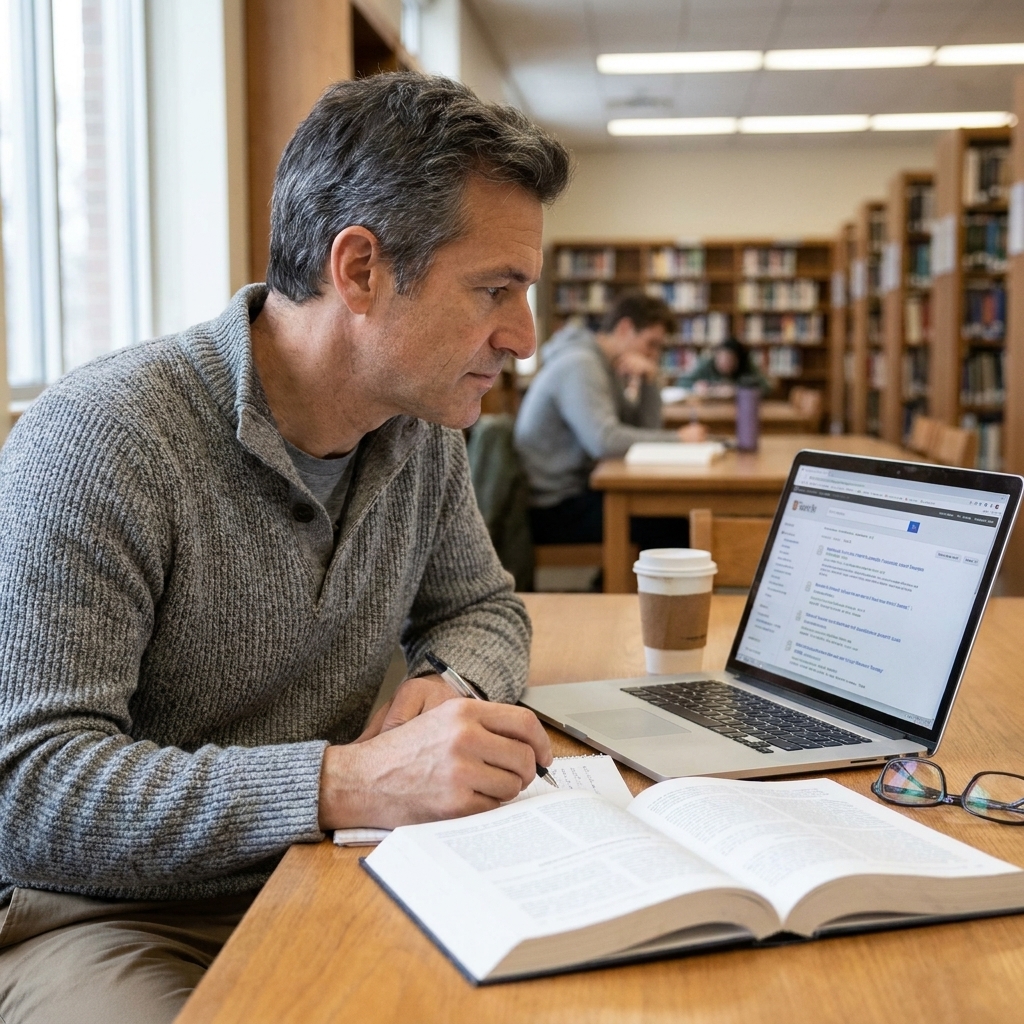
If you want a built-in way to cross-check citations fast, I often use Google Scholar to see whether a claim has reputable support and whether the book is relying on old or disputed findings.
Cross-check key pages
You do not need to fact-check every paragraph to make a good decision. Pick 3 to 5 spots that reveal the author’s accuracy and teaching habits.
My go-to cross-check targets
- Definitions: Intro chapters are where sloppy thinking shows up early.
- One core concept: The thing the entire course depends on.
- One worked example: Are steps correct, and do results match a trusted source?
- One advanced section: Does the book stay coherent when it gets harder?
How to cross-check quickly
- Compare with a known standard reference or a reputable open text in the same field.
- Spot-check key terms in multiple sources. If only the free book is saying it, be cautious.
- For technical topics, run the code, work the problems, or replicate the calculation.
If you are still building your library of trustworthy alternatives, our guide on choosing a free textbook that fits your course pairs well with this step.
Evaluate the learning design
A textbook can be accurate and still be a bad teacher. Since you are spending time, not money, you want a book that helps you build usable skill.
Quality signals
- Clear learning objectives: You can tell what you are supposed to be able to do.
- Practice that ramps up: Easy to hard, with enough repetition to stick.
- Worked solutions or feedback: At least some answers, solution sketches, or checks.
- Real examples: Not just abstract theory, especially in applied fields.
Red flags for self-learners
- End-of-chapter problems with no answers anywhere
- Dense pages with no summaries, no practice, and no structure
- Chapters that assume prerequisite knowledge without stating it
If you are assembling a full plan, I laid out a process for mixing open textbooks with practice resources in Build a Self-Taught Curriculum With Free Open Textbooks.
Check bias and gaps
Accuracy is not only about whether facts are correct. It is also about what is missing, and whether the book presents contested topics honestly.
- Watch for one-source narratives: Especially in history, economics, sociology, and political science.
- Look for limitations: Good authors explain where a model breaks down.
- Notice who is cited: A diverse reference list can be a sign the author is not stuck in a single intellectual bubble.
- Check scope statements: The book should say what it covers and what it does not.
Run a usability test
This is the unglamorous part, but it matters. A book you cannot comfortably read, search, or annotate is a book you will abandon.
- Searchable text: PDFs should allow copy and search. Image-only scans slow everything down.
- Navigation: Table of contents that works, stable headings, consistent numbering.
- Mobile friendliness: If you study on a phone or tablet, check readability early. We have more on devices in Are Some Tablets Better Than Others for eTextbooks?
- Accessibility basics: Reasonable contrast, readable fonts, and descriptive headings.
Use a simple rubric
If you get stuck endlessly evaluating resources, you never study. Here is a lightweight rubric I use to make a decision in one sitting.
| Category | 0 | 1 | 2 |
|---|---|---|---|
| Author transparency | No real author or maintainer info | Some info, unclear expertise | Clear identity and relevant expertise |
| Recency | Old, no updates listed | Date listed but no version notes | Recent updates or clear revision history |
| Citations | Few or none | Some citations, inconsistent | Traceable, consistent, credible sources |
| Review process | No review signals | Informal reviews only | Peer review or visible editorial process |
| Learning design | Hard to learn from solo | Mixed clarity and practice | Structured practice and clear explanations |
How to interpret it: 8 to 10 points is a solid choice. 5 to 7 means “usable with cross-checking.” Under 5 means I keep browsing. It is a decision aid, not a guarantee.
FAQ
Is a free textbook automatically lower quality than a paid one?
No. I have seen expensive textbooks with sloppy errors and free textbooks with excellent review and pedagogy. Price is not a quality filter. Transparency and citations are better filters.
What if the book is accurate but too hard?
That is common. In that case, I keep the book as a reference and learn the topic from a more beginner-friendly source first. Then I come back when the language feels less dense.
How many sources should I cross-check?
For many subjects, one trusted alternative plus a citation check is often enough for a preliminary decision. Save deep verification for high-stakes topics like health, safety, or professional licensing.
Where can I find more free textbooks to compare against?
Start with our hub pages for free etextbooks and online textbooks. Comparing two decent books side-by-side is one of the fastest ways to spot gaps and errors.