

I learned to love free textbooks the way some people love thrift stores. You can find something genuinely excellent, something strange, and occasionally something that looks fine until you try to use it in real life.
When I taught myself web development using public domain books and open courseware, I did not think much about worldview. I was mostly worried about whether the code examples worked. Homeschooling flips that. Families are not just trying to pass a test. You are building a long-term picture of the world for your kids, one chapter at a time.
Worldview can show up in quiet ways, too. A history chapter might treat “progress” as automatically meaning bigger government, smaller government, more technology, or less religion, without ever saying it out loud.
This guide will help you vet free online textbooks for academic bias and worldview without turning every reading assignment into a courtroom cross-examination. The goal is not to find a “neutral” book that does not exist. The goal is to choose materials that are honest about their perspective, accurate with evidence, and a good fit for your family’s educational values.
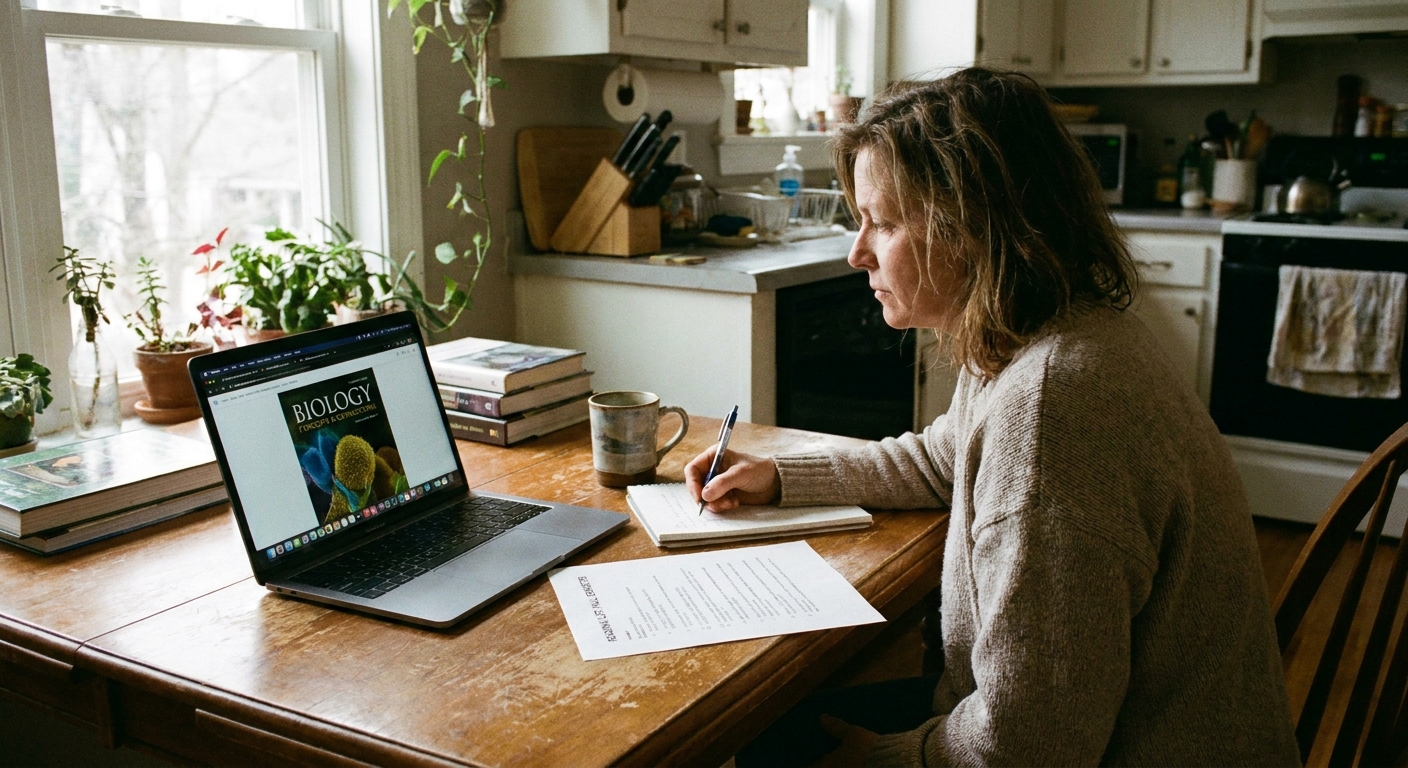
Start with a simple definition of bias
Bias is not automatically “anything I disagree with.” In textbooks, bias usually shows up in three practical ways:
- Selection bias: what facts, examples, eras, or voices get included or ignored.
- Framing bias: the language choices that signal approval, disapproval, inevitability, or moral ranking.
- Evidence bias: how the book uses sources, data, and citations, including whether it cites any counterevidence.
Worldview is broader. It is the set of assumptions a book makes about what matters, what counts as “progress,” what a person is, what a good society looks like, what science can answer, and what belongs in the category of values, religion, philosophy, or ethics.
Perspective vs error vs outdated
One thing that helped me stop arguing with textbooks in my head is separating three different problems:
- Perspective: the author has a lens (and admits it). You can teach from it, discuss it, and compare it.
- Factual error: dates, definitions, quotes, or claims are simply wrong or unsupported. That is not “worldview,” that is bad material.
- Outdated scholarship: the book is not necessarily dishonest, but it is drifting from current research or missing major updates (common with older free editions).
You handle these differently. Perspective calls for discussion. Factual error calls for correction or replacement. Outdated material calls for context, or for swapping in a newer unit when it matters.
The 10-minute parent scan
If you only have ten minutes, do this quick scan first. It catches many common problems that waste homeschool time later.
1) Check the “About” section and licensing
Look for author names, affiliations, and who funded or published the book. Many open textbooks are fantastic, but “free” sometimes means “funded by someone with a mission.” That is not disqualifying. It is something to account for.
If you want a broader process for judging quality, I walk through a full evaluation method here: How to Evaluate a Free Online Textbook.
2) Read the preface and learning objectives
Prefaces often tell you what the authors think education is for. Pay attention to loaded promises such as “correcting misinformation” without showing how they define misinformation or how they handle disagreement.
3) Flip to the index and bibliography
The index reveals what the book treats as important. The bibliography reveals whether the author is engaging with reputable scholarship, primary sources, and more than one school of thought.
4) Pick one pressure point and read that section
Every subject has “pressure points.”
- History and civics: wars, revolutions, colonialism, slavery, civil rights, religion, constitutional interpretation
- Biology: origins, genetics, ecology, human sexuality
- Economics: inequality, regulation, labor, globalization
- Literature: canon choices, moral frameworks, identity
Read 2 to 4 pages closely. If the writing is sloppy there, it is often a clue that you will find similar issues elsewhere.
Red flags to watch for
Some bias is simply perspective. These red flags are about unfairness, low academic standards, or persuasion masquerading as education.
- Strawman language: “Some people believe…” followed by an oversimplified, silly version of the opposing view.
- One-sided certainty: complex debates presented as settled without acknowledging legitimate scholarly disagreement.
- Motivated labeling: terms like “obviously,” “clearly,” “any reasonable person,” used in place of evidence.
- Cherry-picked anecdotes: emotional stories standing in for data, especially when no counterexamples appear.
- Missing primary sources: a history text that rarely quotes speeches, letters, laws, court cases, or contemporary accounts.
- Statistics without context: numbers with no source, no timeframe, no population definition, or no explanation of limitations.
- Unclear author identity: no names, no credentials, no organization, or a site that does not explain editorial standards.
- Persuasion-first worksheet vibe: end-of-chapter questions that mainly invite agreement or personal testimony, not analysis.
Green flags you can trust
I trust a book more, not less, when it is upfront about its scope and limitations. Look for:
- Transparent goals: the text explains what it is trying to teach and what it is not trying to do.
- Defined terms: key words are defined and used consistently.
- Real citations: references you can actually locate, with a mix of classic works and current scholarship where appropriate.
- Counterarguments included: the author represents opposing views accurately before critiquing them.
- Primary sources used well: students are shown evidence, not just conclusions.
- Separation of fact and interpretation: the author signals when they are describing versus arguing.
- Revision history: many open textbooks show updates, errata, or versioning, which can be a good sign that someone is paying attention.
A chapter-by-chapter checklist
When you find a textbook that seems promising, use these questions as you preview each unit. This keeps you from discovering a mismatch halfway through the year.
Language and tone
- Does the chapter use emotionally loaded words for one side and neutral words for the other?
- Are groups of people treated as monoliths?
- Does it confuse describing beliefs with mocking them?
Evidence and sourcing
- Are claims linked to evidence, or do they float as assertions?
- Are graphs and tables sourced and explained?
- Does the chapter cite one tradition of research while ignoring others?
What is missing
- Which voices are never quoted or never taken seriously?
- Are major events or thinkers omitted without explanation?
- Does it ignore the local, religious, philosophical, or cultural context that shaped decisions?
Student agency
- Do questions prompt analysis, or do they nudge students toward a “correct” moral conclusion?
- Are students asked to compare sources and spot limitations?
A quick worked example
Here is what “framing” can look like in a normal-looking paragraph:
Textbook-style sentence: “After the policy was implemented, opponents continued to spread misinformation about its obvious benefits.”
- Framing words: “spread misinformation” and “obvious benefits” tell your student what to think before showing evidence.
- What to check: What are the benefits, measured how, over what timeframe, compared to what alternative?
- A neutral rewrite for discussion: “Supporters argued the policy would produce X and Y benefits. Opponents argued it would cause A and B harms. What evidence does the chapter provide for each claim?”
You are not forcing a “both sides are equal” stance. You are teaching your student to ask for definitions and evidence before conclusions.
Cross-check without doubling work
You do not need to build a second curriculum to verify the first. You need a few lightweight spot checks.
Use triangulation
Pick one important claim and check it using three different types of sources:
- A reference overview (to see mainstream framing)
- A primary source (to see what was actually said or done)
- A contrasting interpretation (to reveal assumptions)
For finding scholarly material fast, I often start at Google Scholar on this site to keep the workflow simple.
Watch for citation laundering
This is when a textbook uses a credible-looking citation chain to give a weak claim a “borrowed” authority. Sometimes the book never engages the underlying data at all, it just cites someone who cites someone else. If a claim feels too neat, chase it back one step and see what the original source actually says.
Check dates and edition drift
A lot of free books are older editions, or they were written quickly and not updated. Old does not automatically mean bad, but it changes how you use the material. If you are weighing an older free option against a newer one, this helps: Are Older Textbook Editions Still Useful?
Age matters
Bias vetting looks different depending on your child’s age.
Elementary
- Expect simplified narratives. Your job is mostly to listen for “always” and “never” language and supply missing context with conversation.
- Choose books with clear, concrete examples and gentle, factual tone. If a text leans preachy, it will usually feel preachy fast.
Middle school
- This is the sweet spot for teaching the habit of asking, “How do we know?”
- Start lightly with primary sources: one quote, one map, one chart, then talk through what it can and cannot prove.
High school
- Raise the bar for citations and for fair representation of disagreement.
- When a chapter touches a hot topic, have your teen identify claims, evidence, and assumptions in writing. A short paragraph is enough.
Where worldview sneaks in
History and civics
- Ask “who has agency?” Does the book treat people as decision-makers or as props moved by forces?
- Check moral vocabulary. Are actions evaluated using a consistent standard, or does the standard change depending on the group?
- Look for primary sources. Speeches, laws, diaries, court opinions, and newspapers keep interpretation tethered to evidence.
Science
- Separate science from metaphysics. A good text distinguishes what the data supports from what someone believes the data means philosophically.
- Notice what counts as a “good explanation.” Some books present one explanatory lens as the only rational lens.
- Check lab activities. Solid science materials push observation and measurement, not just reading and agreeing.
Economics and social science
- Find the assumptions. Models rely on assumptions about human behavior. A fair text states them clearly.
- Watch definitions. Words like “fair,” “exploitation,” “freedom,” and “value” can be used descriptively or morally, sometimes without warning.
- Look for multiple schools. When a book teaches one framework as the framework, it is often smuggling worldview.
Health and psychology
- Check scope claims. A textbook should not promise to answer moral or spiritual questions as if they were clinical outcomes.
- Look for careful language. Good texts discuss uncertainty, limitations, and replication issues.
Align with family values
You usually have three options when a textbook is strong academically but imperfect worldview-wise.
Option 1: Use it as a spine
Keep the textbook for structure, but plan a weekly conversation where you explicitly discuss assumptions and alternatives. This works well for middle and high school.
Option 2: Reframe the questions
If end-of-chapter questions feel leading, rewrite them into neutral prompts:
- Replace “Why is X harmful?” with “What arguments are given that X is harmful, and what evidence supports them?”
- Replace “How should society solve Y?” with “What solutions have been proposed, what tradeoffs do they involve, and who benefits or loses?”
Option 3: Swap one unit
If a single unit is the mismatch, replace just that unit with another chapter or a different free text. Unit studies make this easier, and we have a practical approach here: Homeschool Unit Studies Using Free Textbook Chapters.
Document your choices
When you intentionally choose materials with a clear rationale, it helps with recordkeeping and confidence. A simple note like “Text provided strong primary sources; supplemented with contrasting perspectives in weekly discussions” is often enough.
If you are using open textbooks and want a clean way to record them, this guide is built for homeschool paperwork reality: Documenting Open Textbooks on a Homeschool Transcript.
Mini rubric
If you like making decisions with a little structure, score a candidate textbook from 1 to 5 in each category:
- Transparency: author, publisher, purpose, scope are clear.
- Evidence quality: citations, primary sources, data context.
- Fairness: opposing views represented accurately.
- Student thinking: questions build reasoning, not compliance.
- Fit: worldview assumptions align with your family or are easy to discuss openly.
A “3” is not a failure. It just means you should plan a supplement or more discussion.
Common parent questions
Is it possible to find a truly unbiased textbook?
In my experience, no. Every book has a lens. What you can find are books that are academically responsible: clear sourcing, fair representation of disagreement, and careful language. Those are the ones worth building around.
What if my teen disagrees with our family worldview after reading?
That can be uncomfortable, but it is not automatically a problem. One of the best “bias inoculations” is teaching students to separate understanding an argument from adopting it. If the textbook is strong, use it as practice in analysis and civil discussion.
Should I pre-read everything?
Not everything. Pre-read the pressure points, the preface, and one controversial section per unit. Then read alongside your student when you hit the topics that matter most to your family.
Choose honesty over stealth
The easiest worldview problems to handle are the ones you can see. A textbook that clearly states its assumptions gives you something to talk about. The harder situation is a book that pretends to be purely objective while quietly nudging a student toward one moral conclusion.
If you want a broader homeschool roadmap for using free textbooks effectively, start here: Homeschool Guide. And if you ever find a free textbook that seems too good to be true, trust that instinct and run the ten-minute scan before you hand it to your kid.