

When I first started teaching myself technical subjects from free textbooks, I made the classic mistake: I tried to write down everything. It felt responsible in the moment and it was totally unusable later. College biology and chemistry tend to punish that approach fast because the information is dense, cumulative, and exam questions often test connections, not isolated facts.
This is the note-taking system I wish someone had handed me on day one. It is built for two realities: your professor talks faster than you can write, and you still need notes that actually help you solve problems and explain processes.
Who this works for: lecture-heavy intro bio/chem, dual enrollment, and self-study from open textbooks where you still need a clean way to review.

The goal: notes you can study from in 20 minutes
Good science notes are not a transcript. They are a study tool. Your notes should let you do three things quickly:
- Rebuild the big picture (what is the topic and why does it matter).
- Retrieve key details (definitions, exceptions, conditions, units).
- Practice application (work problems, explain mechanisms, predict outcomes).
If your notes do not support those three tasks, you will end up rewatching lectures or rereading chapters just to understand what you already “covered.”
Set up a simple structure
1 notebook, 3 repeating blocks
Whether you type or handwrite, keep the same layout for every class session. Consistency is what makes review fast.
- Top micro-summary (3 to 6 lines): the day’s topic in plain language.
- Main notes (the bulk): lecture content, examples, worked steps.
- End block: a short checklist of what to review, plus 2 to 4 self-quiz questions.
Two-column notes, simplified
Use a two-column layout (Cornell-style). Make the left column about one-third of the page.
- Left column (keywords + prompts): terms, reaction names, pathway names, question cues.
- Right column (explanations): the meaning, steps, and examples.
This keeps your notes quiz-ready because the left column becomes built-in flashcards.
Pick an organization method you will maintain
I like “one page per lecture” for handwriting and “one doc per lecture” for typing. The key is that lectures stay separate, and you do not mix them into one endless scroll.
If your course is heavy on reading, pair this with a fast pre-read strategy. My favorite is outlined here: The Art of Academic Skimming.
During lecture: capture meaning
Step 1: Listen for signal words
In biology and chemistry, lecturers often mark exam-worthy content with predictable cues. When you hear these, slow down and write more legibly and in complete phrases:
- “This is the mechanism…”
- “You will see this again…”
- “A common mistake is…”
- “The difference between X and Y is…”
- “Under these conditions…”
Step 2: Mark three things aggressively
- Definitions (especially ones that sound similar).
- Conditions (temperature, pH, catalyst present, aqueous vs organic solvent, aerobic vs anaerobic).
- Exceptions (biology is full of them, and instructors often test them).
Use a consistent symbol system, like:
- DEF: definition
- IF: condition
- EX: exception
Step 3: Leave gaps on purpose
When you miss a detail, do not panic-write nonsense. Put a clear placeholder like “??” and keep up with the thread. You will fill gaps as soon as you can using the slide deck, textbook, or a quick question to a classmate.
If your course allows it (and your school’s policy supports it), a short audio recording can help you patch a couple of missing lines later. Do not treat it as permission to stop paying attention.
Biology notes: handle processes
Biology is not just vocabulary. A lot of exam questions come down to: can you explain a process and predict what happens when something changes?
Use the input, output, control pattern
For any pathway or system, capture it like this:
- Inputs: what goes in, what is required.
- Outputs: what comes out, what changes.
- Control points: regulation, feedback loops, rate-limiting steps, enzymes, hormones.
Turn pathways into a story
Instead of writing 12 steps as isolated bullets, write 3 to 5 sentences in your own words that connect them. Then add only the details your professor emphasizes.
Anchor facts to a why
If you must memorize a detail, add one short reason next to it. Example: “tight junctions prevent leakage” is easier to retain than “tight junctions: occluding.”
When diagrams get intense, I use a specific memorization approach that keeps you from recopying the same figure over and over: Study and Memorize Complex STEM Diagrams.
Chemistry notes: solve problems
Chemistry often punishes pretty notes that do not include steps. Your notes should read like worked examples with commentary.
Always write the unit and the setup
For calculations, do not only write the final formula. Write:
- Given: values with units
- Find: what the question asks for
- Plan: what principle you are using (stoichiometry, equilibrium, thermodynamics)
- Setup: the dimensional analysis or equation substitution
- Answer: with units and significant figures as required by your course
This takes a few extra seconds in lecture, but it saves you hours later when homework gets harder.
A tiny example you can copy
Example (molarity):
- Given: 0.50 mol NaCl, 2.0 L solution
- Find: M
- Plan: M = mol / L
- Setup: 0.50 mol ÷ 2.0 L
- Answer: 0.25 M
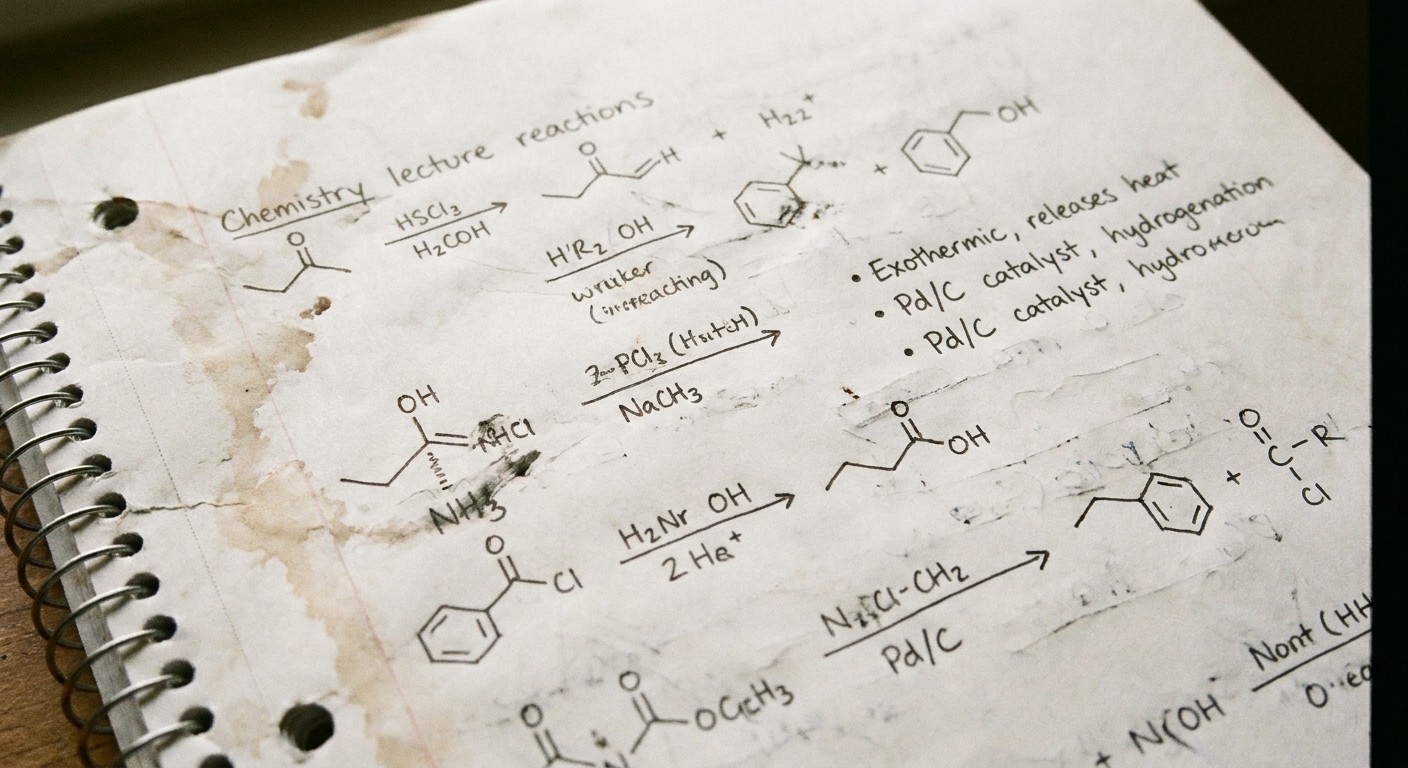
Reaction notes: store patterns
For reactions (especially organic), do not just copy reagents. Add one line of meaning:
- What changes: oxidation, reduction, substitution, addition.
- What drives it: nucleophile strength, leaving group, stability.
- Typical trap: the condition where students pick the wrong product.

Within a day: repair and compress
If you do one thing consistently, make it this. The first day after lecture is where your notes either turn into a study tool or turn into a pile of noise.
Minute 0 to 5: Repair
- Fill “??” gaps using slides or the textbook.
- Fix unclear wording.
- Underline the 3 to 7 items most likely to reappear.
Minute 5 to 12: Compress
- Write a micro-summary at the top: “Today was about ___, and the key idea is ___.”
- Create 2 to 4 self-quiz questions at the bottom.
Minute 12 to 15: Connect
Add one line that ties today to last week. Example: “This enzyme regulation helps explain why the rate changed in last lecture’s pathway.”
This is the same idea I use when I build self-study plans from big books. If you want a structured way to keep pace with heavy reading, see The Syllabus Strategy for a 500-Page Textbook.
Weekly review: avoid panic
You do not need marathon study sessions if you do short, high-quality loops.
The 3-pass weekly review (45 minutes total)
- Pass 1 (10 minutes): skim your micro-summaries and headings. Only rebuild the map.
- Pass 2 (20 minutes): answer your self-quiz questions without looking. Mark what you miss.
- Pass 3 (15 minutes): do 3 to 5 practice problems (chem) or explain 2 processes out loud (bio).
If your notes are not producing practice, they are not finished. For chemistry especially, the problems are the learning.
Lab notes: what matters
Lecture notes and lab notes are different animals. In lab, I write for one goal: make the lab report and the post-lab questions easy later.
- Purpose: what you are testing and what would count as evidence.
- Procedure: only the steps that are easy to mess up (not every sentence from the handout).
- Observations: colors, precipitates, temperatures, time stamps, anything surprising.
- Data + units: raw numbers, not just “calculated results.”
- Error sources: one or two realistic ones (contamination, heat loss, measurement limits).
- Post-lab prompts: write the questions you know you will be asked to answer.
Paper vs digital
Both work. I choose based on what the class demands.
- Paper: fast for quick diagrams and messy mechanisms.
- Tablet + stylus: great for annotating slides, drawing structures, and keeping everything searchable.
- Laptop typing: fine for concept-heavy bio lectures, but I still add hand-drawn figures somewhere or I forget them.
Whatever you pick, the rule stays the same: one file per lecture, and a micro-summary plus self-quiz every time.
When you fall behind
It happens. Science courses move. Here is the recovery plan that has saved me more than once.
Step 1: Stop trying to catch up perfectly
Set a minimum viable goal: get to the point where you can do this week’s homework and understand this week’s lecture. Older gaps can be patched as you go.
Step 2: Make a one-page backlog list
- List each missed lecture as a single line.
- Next to it, write one deliverable: “Write a 6-line micro-summary” or “Do 10 end-of-chapter problems.”
Step 3: Time block two short sessions a day
Even 25 minutes + 25 minutes beats a single exhausted Saturday. If fatigue is the real enemy, I wrote a full breakdown here: Overcoming Textbook Fatigue With Time Blocking.
A format you can copy
Here is a clean, repeatable layout. Use it for both biology and chemistry and customize the middle.
Top of page
- Date + lecture topic
- Micro-summary: 3 to 6 lines in your own words
- Key terms: 5 to 10 items
Middle of page
- Main notes: two-column capture
- Worked example box: 1 to 2 problems or mechanisms
Bottom of page
- Self-quiz: 2 to 4 questions
- Confusions: 1 to 3 items to ask about in office hours or discussion
Common mistakes
- Copying slides word-for-word and never adding your own explanation.
- Highlighting everything so nothing stands out during review.
- Keeping definitions without examples (biology) or formulas without setups (chemistry).
- Never testing retrieval. If you are not trying to recall without looking, you are mostly rereading.
- Waiting until exam week to compress and organize, which is when you are least able to think clearly.
Notes should match the textbook
I love good open textbooks, but even the best book cannot replace the professor’s emphasis. Your notes are the bridge between the two.
If you are using a free or open textbook and want a quick way to check whether it is solid, current, and usable for problem practice, this guide helps: How to Evaluate a Free Online Textbook.
And if you are still assembling your overall study approach, the Study Tips hub is a good place to browse what has worked for other self-learners and overloaded students: Study Tips.
If you only do two things
If you only adopt two habits this week, make them these:
- Use two-column notes with prompts on the left. That turns your notes into a self-quiz tool automatically.
- Do the 15-minute repair and micro-summary within a day. That is what keeps you from falling into the pre-exam panic spiral.