

I learned to love active recall the hard way: by building my first web dev skills from free textbooks and realizing that rereading felt productive but barely moved the needle. The breakthrough was simple and slightly uncomfortable. Stop “reviewing” and start retrieving. If you can pull an idea out of your head on demand, you own it. If you cannot, the book is just keeping it warm for you.
This guide walks through three tools that make retrieval practice practical: self-testing, flashcards, and concept maps. You do not need special apps, expensive prep books, or a perfect memory. You need a repeatable system.

What active recall is and why it works
Active recall means you practice pulling information from memory, instead of pushing information into your eyes again. The difference matters because exams are almost always retrieval tasks: you have to produce an answer with limited cues.
When you retrieve, you do two things at once:
- Strengthen the memory trace (recall becomes faster and more reliable).
- Expose gaps (you find what feels familiar but is not usable).
If you want a quick reality check: close the book and try to explain the topic out loud. If you stall, that is not a motivation problem. That is a study method problem.
Active recall pairs especially well with spaced repetition, where you revisit questions over multiple days. Spacing is not the point of this article, but if you want to fold it into your routine, the flashcard section below includes a simple schedule.
Technique 1: Self-testing
Self-testing is the backbone of fast exam prep because it scales. You can do it with any subject, any textbook, and any amount of time.
Start with the book closed
Most people reverse this. They read first, then quiz themselves at the end “if there is time.” Flip it:
- Preview the section headings, learning objectives, and key terms.
- Write 5 to 10 questions you expect the section to answer.
- Read once with the goal of answering those questions.
- Close the book and answer from memory.
- Check and correct using the text, then re-answer without looking.
Use three levels of questions
If all your questions are definitions, you will do fine on definitions and struggle everywhere else. Build a mix:
- Level 1 (facts): “What is X?” “List the steps of Y.”
- Level 2 (connections): “How does X relate to Y?” “Why does changing A affect B?”
- Level 3 (application): “Given this scenario, which concept applies and why?”
Two self-tests under 10 minutes
- Blank-page recall: Set a timer for 5 minutes and write everything you can about the topic, then compare to the text and circle missing chunks.
- Teach-back sprint: Explain the concept out loud as if you are tutoring a friend. When you hesitate, mark that spot in your notes and test it again.
If you want a companion method for reading dense chapters efficiently before testing, pair this with SQ3R for Dense Textbook Chapters or The Art of Academic Skimming.

Technique 2: Flashcards
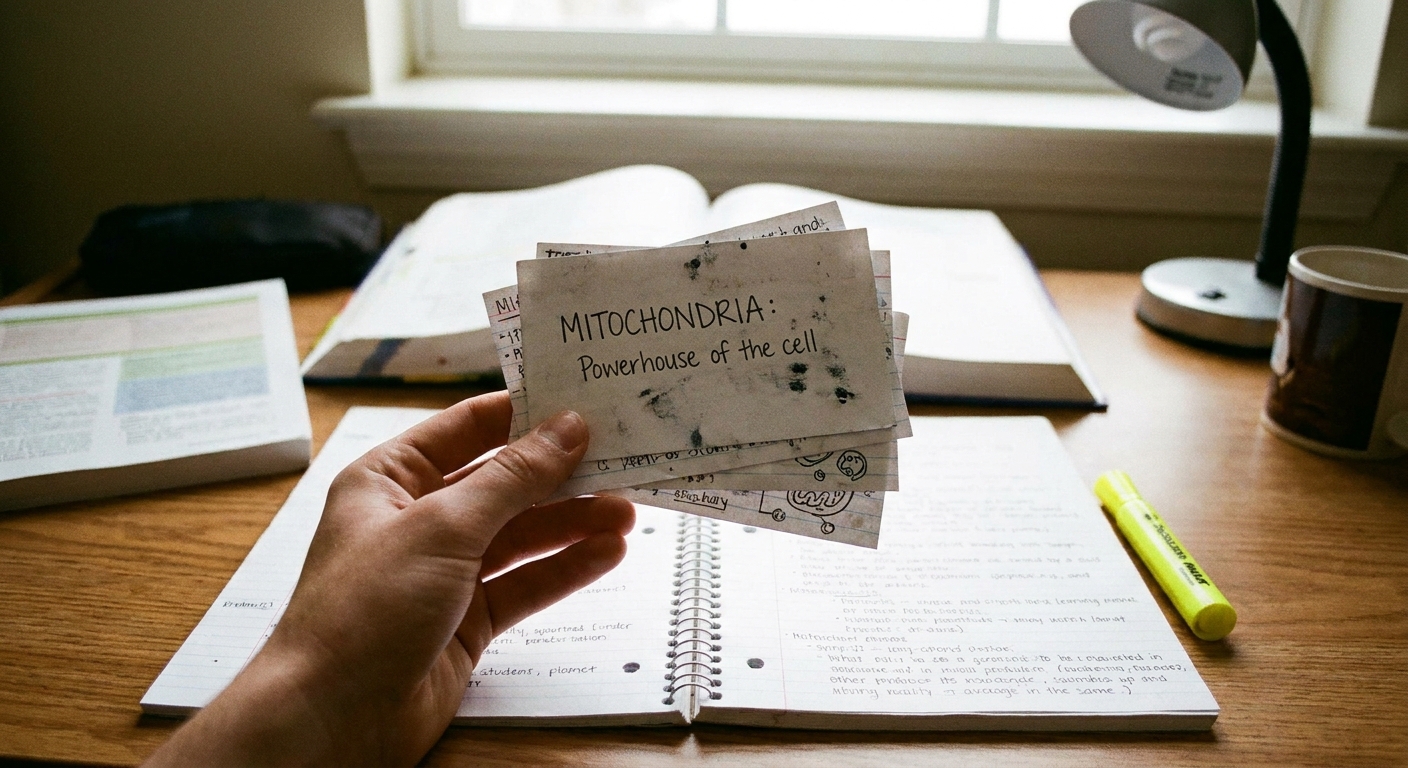
Flashcards are powerful, but only when they are built for retrieval, not recognition. Bad flashcards feel easy and waste time. Good flashcards feel a little annoying, and that is why they work.
Two rules for better flashcards
- One card, one idea. If a card has three facts, you will miss one and still mark it “kind of right.”
- Make the prompt specific. “Explain photosynthesis” is too broad. “What are the inputs and outputs of photosynthesis?” is testable.
Flashcard formats that work
1) Basic Q and A
- Front: “What is opportunity cost?”
- Back: “The value of the next best alternative you give up when you choose an option.”
2) Cloze deletion
- Front: “In classical conditioning, the _____ stimulus initially produces no response.”
- Back: “Neutral stimulus.”
3) Process cards
- Front: “List the steps of cellular respiration in order.”
- Back: “Glycolysis, Krebs cycle, electron transport chain.”
4) Example and non-example
- Front: “Give an example of a confounding variable, and a non-example.”
- Back: “Example: caffeine intake affecting both sleep and test performance. Non-example: a variable unrelated to both.”
A simple spaced schedule without an app
If you are using paper cards or a basic notes app, try this cadence:
- Day 0: Make cards right after learning.
- Day 1: Review all new cards.
- Day 3: Review missed cards plus anything that felt slow.
- Day 7: Review again, focusing on application cards.
- Weekly until exam: Short maintenance sessions.
Common flashcard mistakes
- Mistake: Flipping too soon. Fix: Wait 5 to 10 seconds and attempt an answer, even if it is messy.
- Mistake: “I knew it” grading. Fix: Say the full answer out loud. Partial recall counts as a miss.
- Mistake: Copying textbook sentences. Fix: Rewrite in your own words, then add one example.
If you want a clean way to manufacture flashcards from your textbook, see Turn Textbook Glossaries Into Spaced Repetition Flashcards.
One quick clarification: I do not have a ready PDF download for this guide. If you want an offline version, copy the routines into your notes app or a single page in your notebook and treat it like a checklist you reuse.
Technique 3: Concept maps
Concept maps are underrated because people confuse them with decorative mind maps. A concept map is not about pretty bubbles. It is about relationships.
When to use a concept map
- You can recall definitions but cannot solve problems.
- Everything feels disconnected across chapters.
- You need to answer “compare and contrast” or “explain why” questions.
Build one in 15 minutes
- Pick one central concept (the exam unit, not the entire course).
- Dump key nodes: 10 to 20 terms or ideas from memory first.
- Add link phrases between nodes: “causes,” “requires,” “inhibits,” “is an example of,” “is measured by.”
- Force cross-links between branches. This is where learning happens.
- Test it: cover part of the map and try to recreate it on blank paper.
Make it exam-shaped
The best concept maps are built around the kinds of questions you will see. For example:
- Science: connect variables, mechanisms, and outcomes.
- History: connect events, causes, stakeholders, and consequences.
- Programming: connect concepts to use cases and failure modes.
If your course is heavy on visuals, fold concept mapping into your diagram practice. This pairs nicely with Study and Memorize Complex STEM Diagrams.

Put it together
Here is a repeatable session I use when I am prepping quickly from a textbook chapter.
Option A: 30 minutes
- 5 min: Skim headings and objectives, write 5 questions.
- 10 min: Read with a pen, hunting answers.
- 10 min: Close the book and self-test on your 5 questions plus blank-page recall.
- 5 min: Fix gaps, create 5 flashcards from the misses.
Option B: 60 minutes
- 10 min: Pre-questions and a quick scan of the section.
- 20 min: Read and annotate lightly.
- 15 min: Self-test (written answers or problem attempts).
- 10 min: Flashcards for weak spots.
- 5 min: Mini concept map with cross-links.
If you struggle with sticking with it over days, active recall benefits a lot from time-blocking. See Overcoming Textbook Fatigue With Time-Blocking.
Common problems
“Active recall takes longer than rereading.”
At first, yes. Then it gets faster because you stop spending time on illusions of learning. A good compromise is shorter recall cycles: read 2 pages, test. Do not read 20 pages and then discover you retained 3.
“I blank out and it feels awful.”
Blanking out is feedback, not failure. Use graduated hints:
- Hint 1: look at the heading only.
- Hint 2: look at one key term.
- Hint 3: look at the first line of the explanation.
Then close the book and answer again. The goal is to minimize help over time.
“I do practice questions but still miss exam questions.”
That usually means your practice is too narrow. Add transfer prompts:
- “What would change if this variable doubled?”
- “How would you explain this to a beginner?”
- “What is the most common mistake here?”
- “What is a real-world example?”
“My flashcards explode into thousands.”
That is a sign you are carding everything instead of carding what is testable. Prioritize:
- Learning objectives
- Instructor emphasis
- Problem types you miss
- Terms that connect multiple chapters
Week before the exam
- Switch from input to output: 70 to 90 percent of your time should be retrieval (tests, cards, teach-back).
- Track misses, not hours: your weak list is your real study plan.
- Interleave topics: mix two units in one session so your brain practices choosing the right tool, not just repeating one.
- Do one cumulative self-test: at least two days before the exam so you have time to patch holes.
If you are working from a huge book and not sure what to prioritize, the approach in The Syllabus Strategy for a 500-Page Textbook is a lifesaver.